
ITF Taekwon-Do vs Karate — Which Martial Art is Right for Your Child in Reading?
Updated: Apr 17
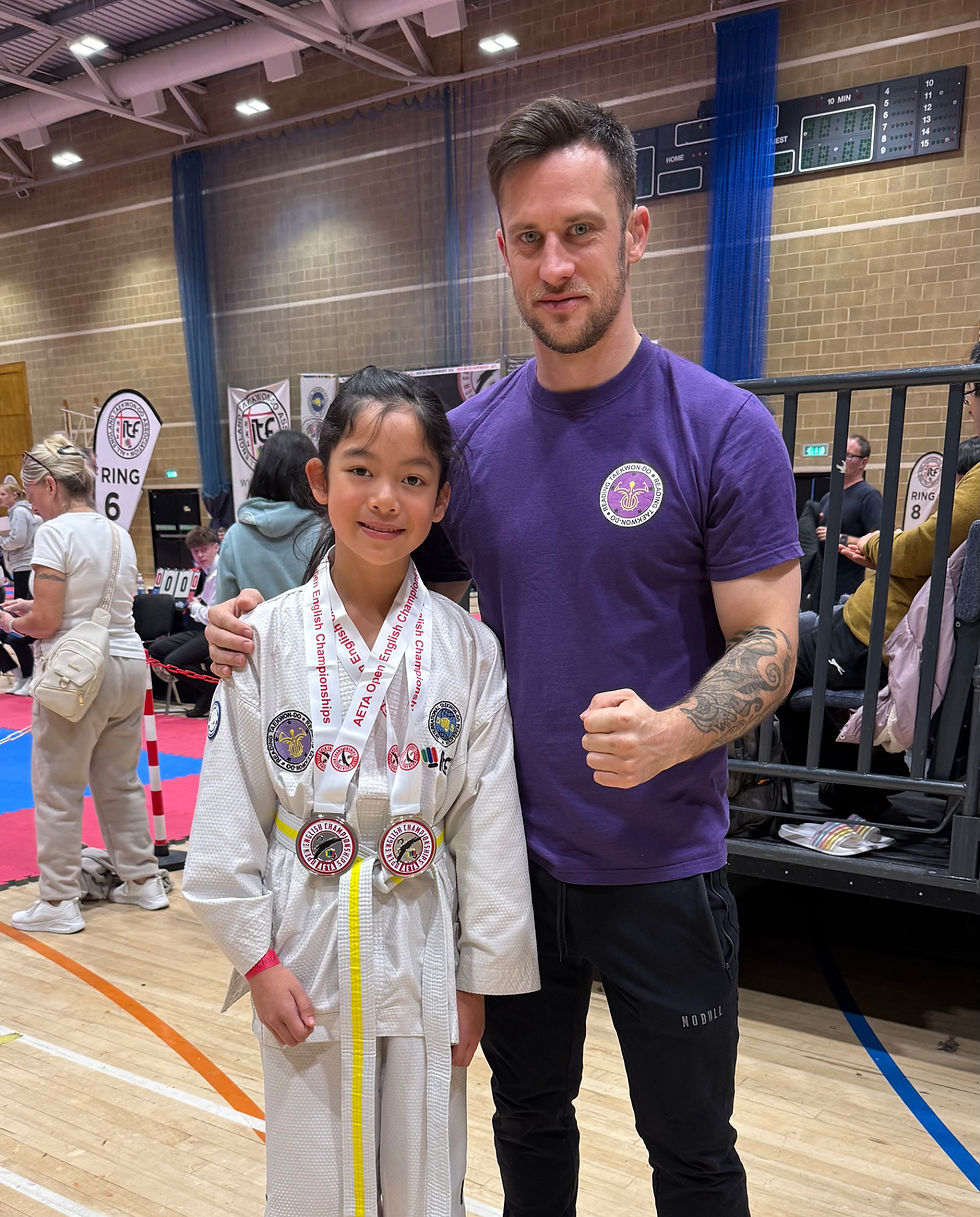
If you're a parent in Reading searching for martial arts classes for your child, there's a good chance you've found yourself going back and forth between Taekwon-Do and Karate. They look similar on the surface.. Doboks, belts, bowing, discipline, but they are genuinely different arts with different emphases, different cultures, and different experiences for a child training in them.
I'm James Dilley, Chief Instructor at Reading Taekwon-Do and a 5th Degree ITF Black Belt with over 23 years experience in ITF Taekwon-Do. I competed at national and European level for over a decade, and I've been coaching students of all ages since 2009. I have an obvious preference, but I'll give you an honest breakdown so you can make the right decision for your child, not just the one that suits me.
What is Karate?

Karate is a Japanese martial art developed on the island of Okinawa. It focuses primarily on striking. Such as punches, kicks, blocks and open handed techniques with an emphasis on controlled, precise movements and strong stances.
There are several styles of Karate, including Shotokan, Wado-Ryu and Kyokushin, each with slightly different emphases. Both Karate and ITF Taekwon-Do are complete striking arts that develop upper and lower body technique — the difference is not one being more balanced than the other.
Where they diverge significantly is in sparring competition format. Most Karate competition uses a point stop format. Techniques are exchanged, a point is scored, and the action stops before resetting.
ITF Taekwon-Do uses continuous sparring, where the action doesn't stop after a scoring technique. This single difference fundamentally shapes how each art is trained and how students learn to fight. In ITF, you cannot land one technique and disengage, you must maintain pressure, control distance continuously, and string combinations together to outwork your opponent over the course of the round.
It develops a very different fighter to point stop formats, and in many ways a more complete one.
What is ITF Taekwon-Do?

ITF Taekwon-Do is a Korean martial art founded by General Choi Hong Hi on the 22nd March 1966. ITF — International Taekwon-Do Federation — is the original governing body of Taekwon-Do and is distinct from the Olympic version of the sport, which is governed by World Taekwondo (WT).
ITF Taekwon-Do is known for its dynamic, powerful kicking techniques. Including jumping kicks, spinning kicks and combination kicking. But it is a complete martial art that also covers hand techniques, patterns, sparring and self defence.
The art is underpinned by five tenets: courtesy, integrity, perseverance, self control and indomitable spirit, which shape the culture of every ITF school.
At Reading Taekwon-Do we train under ITF England, with pathways to National, European and World Championships.
The Key Differences for Children
Kicking vs striking
Both ITF Taekwon-Do and Karate are complete striking arts. Taekwon-Do translates literally as "the art of the hand and foot" hand and foot techniques are equally fundamental to the art. It is actually World Taekwondo (WT), the Olympic version, that pulls emphasis heavily toward kicking due to its scoring system.
ITF Taekwon-Do maintains a genuine balance between hand and foot techniques throughout its syllabus, patterns and sparring. Where ITF differs from Karate is not in that balance, but in the nature of the techniques themselves.
ITF kicking is characterised by dynamic, powerful and often jumping or spinning techniques, while the hand techniques are precise and varied. Karate's technique set, depending on style, has a different flavour and emphasis but is similarly complete.
Patterns
Both arts use solo practice routines — called Kata in Karate and Tul in ITF Taekwon-Do. These are sequences of techniques practised alone, developing memory, precision, coordination and discipline. ITF patterns are generally considered technically demanding and highly structured, with a strong emphasis on sine wave motion and breath control.
Sparring
ITF Taekwon-Do sparring is semi contact and uses protective equipment. It is controlled and safe, focused on developing timing, distance and composure. Karate sparring varies significantly by style. Some styles are light contact point sparring, others are full contact. It is worth checking the specific approach of any school you consider.
Competition
Both arts offer competition pathways. ITF Taekwon-Do competes in patterns, sparring, power test and special technique at club, national and international level. Several Reading Taekwon-Do students have competed within months of starting, including white belts winning gold medals at their first tournament.
Culture and values
Both arts emphasise respect, discipline and self improvement. In my experience, ITF Taekwon-Do has a particularly strong tradition of technical excellence and philosophical grounding through the ITF tenets. These are not just words, they shape how students treat each other in class and beyond.
Which is Better for Your Child?
Honestly, it depends less on the art and more on the school and instructor.
A good ITF Taekwon-Do instructor will develop your child more effectively than a poor Karate instructor, and vice versa. The quality of teaching, the culture of the school, the instructor's experience and the environment your child trains in will have far more impact on their development than the style itself.
That said, if your child is energetic, enjoys dynamic movement, and you want a martial art with a strong philosophical foundation, clear technical structure and genuine competitive pathways — ITF Taekwon-Do is an excellent choice.
If your child is drawn to a more Japanese or Okinawan tradition of martial arts, with Karate's distinct technique set and culture, that may suit them better.
The best thing you can do is try both if they are available locally. At Reading Taekwon-Do we offer a 14 day trial for £25 so there is no long term commitment. Just come and see if ITF Taekwon-Do feels right for your child.
Try ITF Taekwon-Do in Reading
Reading Taekwon-Do runs martial arts classes every Tuesday and Thursday, 7:00pm to 8:30pm at Kings Academy Prospect, Honey End Lane, Reading RG30 4EL.
Classes are open to children aged 8 and above, all grades welcome.
Book your 14 day trial for £25 and receive a free Student Manual when you sign up.


Comments